The role of the heroine differs somewhat in Miyazaki and Disney films. As I mentioned earlier, coming from a historically oppressive culture towards women, you would think that such strong female roles would not be an as important part in Miyazaki's films, but feminism is emphasised more throughout his work than that of Walt Disney who was brought up in the West.
Starting with the suffrage movement in the 1820's, up to the "second wave" feminists post 1960's, America has always adknowleged the tradition of femenism. Disney does include strong female characters such as Mulan and Pocahontas...but they are not as strong a femenist role model as the females we see in Miyazaki's animations. His females are strong, they retain positions of power, freedom and indepence. Disney's females - even though overcoming obstacles and straying away from the duties they are expected to complete as a female (Mulan running off to be in the army,) they are still held back or constricted by a male authority (at the end Mulan choses to accept the path of marriage rather than continue her life as a soldier and reverts back into a submissive feminine role.)
References taken from this article
Friday, 2 November 2007

Themes of nature in both Miyazaki's and Disney's films.
Both Disney and Miyazaki films support the recurring theme that humanity must live in harmony with nature, but that it is a constant struggle.
"In snow white, the analogue between discovery and horror is evident, particularly with respect to nature in general and the forest in particular."
In one scene Snow White is banished to the forest, forced to run through scenes of terifying monstrous trees but then finds herself in the sunshine surrounded by a choir or friendly animals.
"In snow white, the analogue between discovery and horror is evident, particularly with respect to nature in general and the forest in particular."
In one scene Snow White is banished to the forest, forced to run through scenes of terifying monstrous trees but then finds herself in the sunshine surrounded by a choir or friendly animals.

Snow white in the forest with the animals
In Miyazaki's Princess Mononoke, Ashitaka (the male protagonist) is cursed by evil from the forest which is a "materialization of the natural world's war with man."
Disney's Bambi emphasises the incompatability of the animal kingdom and the human worlds.
A lot of the forest creatures in Miyazaki's Princess Mononoke have human qualities but it is not permitted for humans to live harmoniously amongst them.

The Kodama in the forest in Princess Mononoke
Miyazaki and Walt Disney
I've found some interesting articles on the internet comparing his work and Walt Disney's. Of particular interest is the role of females (East vs West arguments) and how even though Miyazaki comes from a culture that is historically far more oppressive towards women than America, his females always assume and retain positions of power. In contrast to this, Disney's heroines – although they stray from their feminine roles and go on a journey to become more self-reliant, they still never entirely free themselves from the comforting yet controlling restraints of male authority (“One day my prince will come.”)
Another aspect I've found intriguing is comparing Miyazaki's recurring theme of nature with Disney's approach. The “goodness” of nature is consistent throughout Disney's work but both show the permanent struggle between humans and nature.
I have also been looking at the “Good vs Evil” theme throughout both films. Miyazaki's characters are never wholly evil and are given the chance to see their errors and change, whereas Disney seems to want to emphasise between “right” and “wrong” behaviour often killing off the evil character (the Evil Queen in Snow White.)
My one concern is whether I concentrate on just this one aspect, or include all aspects such as themes, narrative, plot storyline and characters, comparing both using the East vs West approach, including historical, cultural, social and political references.
Another aspect I've found intriguing is comparing Miyazaki's recurring theme of nature with Disney's approach. The “goodness” of nature is consistent throughout Disney's work but both show the permanent struggle between humans and nature.
I have also been looking at the “Good vs Evil” theme throughout both films. Miyazaki's characters are never wholly evil and are given the chance to see their errors and change, whereas Disney seems to want to emphasise between “right” and “wrong” behaviour often killing off the evil character (the Evil Queen in Snow White.)
My one concern is whether I concentrate on just this one aspect, or include all aspects such as themes, narrative, plot storyline and characters, comparing both using the East vs West approach, including historical, cultural, social and political references.
Monday, 5 March 2007
Visual Examples

My Neighbors the Yamadas is another Studio Ghibli film and is a far cry from the typical anime film that we've all come to know. First off, the visual style is completely different from standard anime. There is no cell-style here, it just looks pretty much like a comic strip come to animated life... which is convenient considering My Neighbors the Yamadas started out as a newspaper comic strip. Although the animation was all done with computers, it really appears as if it were made completely from hand drawn pencil sketches with watercolors. Only the occasional sweeping camera angels give hint that this work of art actually exists in a 3D computer environment.
I really like this style, it looks like it has been painted with watercolours.
Visual Examples
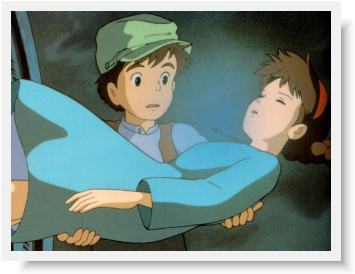
Much of Miyazaki's work depicts the path of personal growth and changes of a character from childhood to maturity. In the beginning, the protagonist (almost always a girl) is usually naïve, overly reliant on others, or selfish. As the story progresses into a crisis, the character is confronted with challenges, hardships, and failure, which she learns to overcome by relying on her own will and inner strength. In the end, these characters are able to make their own decisions and gain self-reliance (wikipedia)
Visual Examples
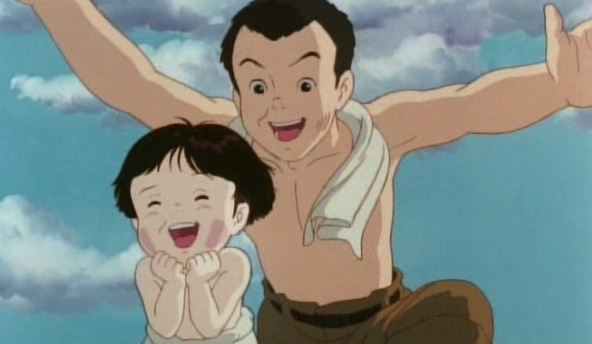
Isao Takahata is the co-founder of Studio Ghibli with Hayao Miyazaki. His film Grave of the Fireflies is widely considered one of the greatest animated films ever made. Takahata's films have had a major influence on Hayao Miyazaki, prompting animator Yasuo Ōtsuka to say that Miyazaki gets his sense of social responsiblity from Takahata and that without Takahata, Miyazaki would probably just be interested in comic book stuff. (wikipedia)
Visual Examples

One of Miyazaki's influences is french animatior Paul Grimault. From this image I can see where Miyzaki has taken this influence, with the detail and softness of the image and the way nature is included.
Visual Examples
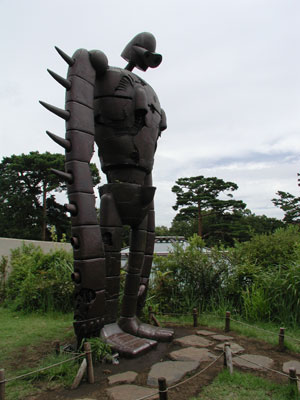
A desire to share the magic of this creativity especially with his littlest fans led to Miyazaki's latest production: the Studio Ghibli Museum. Here the other side of Miyazaki is on full display: the childlike enthusiast, bursting with inventiveness. The multicolored building pokes out like the stub of a rainbow from a wooded corner of a vast Tokyo park. A towering metal sculpture of a robot character from his film Castle in the Sky stands sentry. Inside, a handcrafted fan whirs like an airplane propeller from the glass ceiling of a four-story atrium. Elf-size doors lead to secret passageways, and tiny benches line the theater showing new Miyazaki film shorts. (http://www.time.com/time/printout/0,8816,179531,00.html)
Visual Examples
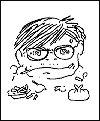
"Miyazaki Self - Portrait."
Miyazaki would not be so successfull if it wasn't for his incredible ability to draw. This image obviously doesn't reflect the same style as his manga and film drawings but is still interesting.
Visual Examples

Perhaps Miyazaki's most famous film is Oscar-winning Spirited Away—the tale of a 10-year-old's quest to deliver her parents from a spell that has turned them into pigs. Like many of Miyazaki's films it's a rumination on the importance of self-reliance, selflessness and the challenge of growing up. (http://www.time.com/time/asia/2006/heroes/at_miyazaki.html)
I love the style of drawing and the colourfulness of this film.
Visual Examples

It is the top part of this image that is interesting. The environment plays a key thematic role in almost all of his films. He believes that perfect coexistence between humans and nature is nearly impossible, and he explores this idea while maintaining that “a wonderful meeting or beautiful thing can exist.” (http://redstudio.moma.org/contests/character/) Several motifs recur in many of Miyazaki's films. Especially in later work, he deliberately paces his films to allow brief excursions into the animated environment. The image of wind blowing gently across fields of grass or grain has been used in several of his films.
Visual Examples

Before the creation of Studio Ghibli it was Miyazaki's Manga comics that he concentrated on the most. These hand-drawn comics formed the storys and styles for his films and this particular one 'Nausicaä of the Valley of Wind' was turned into a film in 1984.
Visual Examples

Almost all of the frames in Hiyazaki's movies are hand drawn. Along with traditional drawing some 3D computer graphics are used to animate parts and create models. In Princess Mononoke (above) when the monster Tatari-Gami is shot with Ashitaka's arrow, a model of the creatures feelers were made using all angles and views. CG was used to depict the precise movements.
Hayao Miyazaki
For my research I would like to explore the work of Hayao Miyazaki, the animated film director and co-founder of Studio Ghibli. Miyasaki has created many successful animated feature films including "Princess Mononoke" and "Spirited Away." I am particularly interested in his drawing styles, manga character designs and also the recurring themes in his films such as our relationship with technology and nature.
Subscribe to:
Posts (Atom)